
Healing Styles in Games: Triage, Shields and HoTs
Reactive or proactive, shields or heals over time: the four ways healers keep a party alive in any game, and how Heal Me Faster turns each into a style you pick.
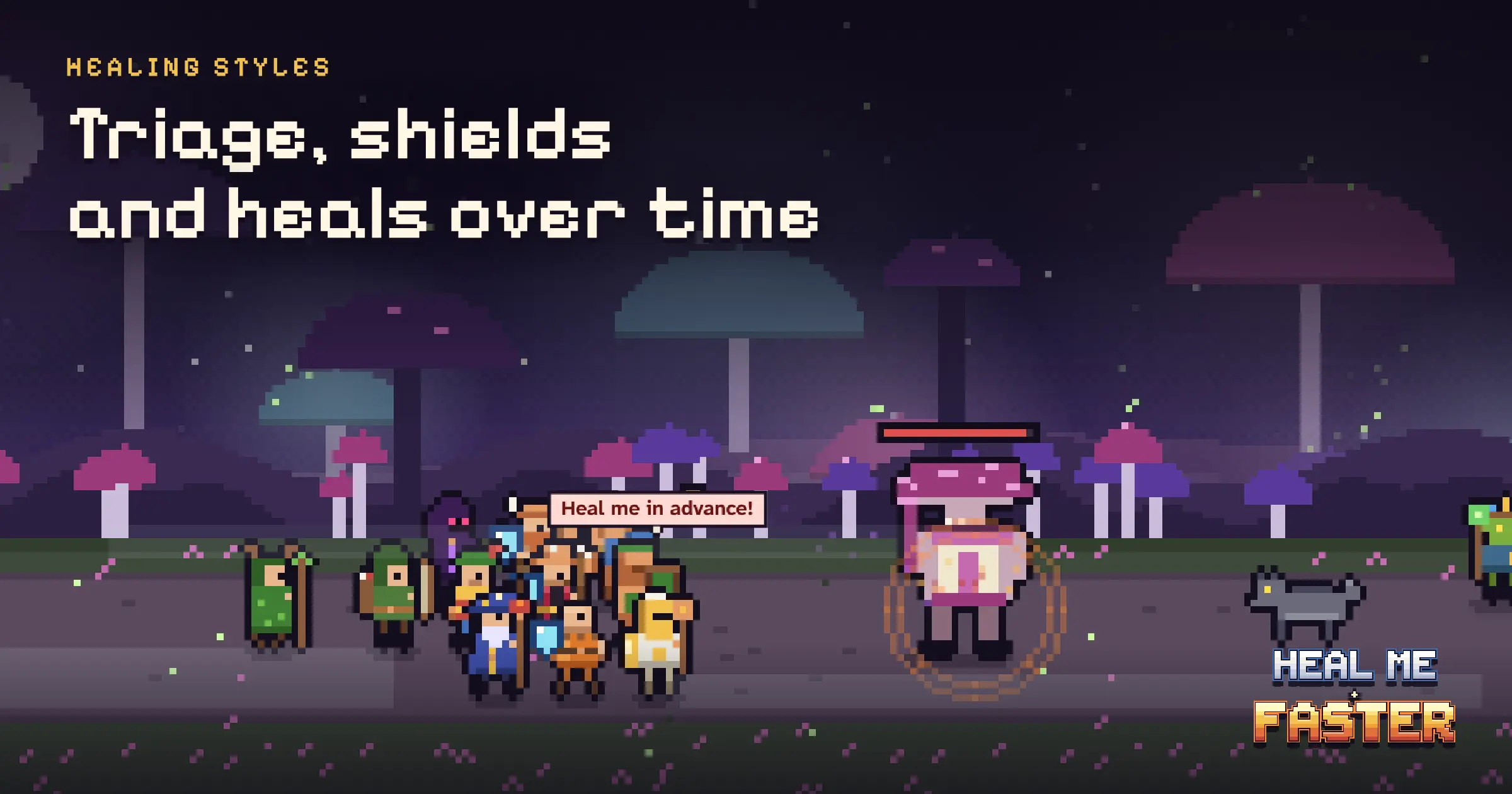
Healers in games keep people alive in four main ways: reactive healing (triage: heal whoever is hurt, most urgent first), proactive healing (shields that stop damage before it lands), heal-over-time rhythm (cheap heals that keep ticking while you keep casting), and group or "smart" heals that spread healing across many people at once. Every good healer uses all four; your style is the one you reach for first.
I'm Jeff, and I made Heal Me Faster, a healer game where that lean is a choice you make: four healing styles, each bending the same seven spells toward one of those approaches. The first half of this post is about healing in any game. The second half is how mine does it.
The four healing styles at a glance
| Style | You heal... | Best against | Weak against | In Heal Me Faster |
|---|---|---|---|---|
| Reactive (triage) | after the damage, most urgent first | unpredictable damage | a spike that kills before your heal lands | Triage |
| Proactive (shields) | before the damage | hits you can see coming | damage that never comes | Warden |
| Heal over time | while it happens | steady damage | sudden bursts | Rhythm |
| Group and smart heals | many people at once | damage that hits everyone | one person in trouble | Shepherd |
What is reactive healing?
Triage is a word from medicine: sorting the wounded by who needs help first. A reactive healer watches the health bars, picks the most urgent target and lands a direct heal. The skill is judgment, not speed: a tank at 40% is often safer than a mage at 60%, because the tank survives the next hit and the mage doesn't. It wastes little, since you only heal damage that's there, but you're always one cast behind. Icy Veins's guide (as of October 2026) calls WoW's Holy Priest "primarily a reactive healer."
I'm at forty percent and I'm fine. The mage at sixty is not fine.
What is proactive healing?
A proactive healer spends mana before the damage: absorb shields and damage reduction, so the hit never fully lands. It rewards knowing the fight. When a boss winds up a tank buster, a shield cast now is worth more than a heal cast after. The catch: a shield on someone who doesn't get hit just expires. Icy Veins's Discipline Priest guide calls it "a very proactive style burst healer," and FFXIV's Scholar and Sage are its barrier healers, "focused on preventing damage."
What about heals over time and group heals?
A heal over time (a HoT) heals a little at a time over several seconds. HoTs are cheap and usually instant, so HoT healers settle into a loop: put them out, keep them rolling, never stand still. They smooth out steady damage and struggle with spikes.
Group heals hit everyone at once, and "smart" heals pick their own targets, like WoW's Prayer of Mending, which jumps to another ally after it heals. One cast, many people. On one person in trouble, a group heal is the most expensive way to save them, so count heads before you cast.
Reactive or proactive: which is better?
Neither. It depends on what the damage looks like:
| If the damage... | Your best answer |
|---|---|
| is a big hit you can see coming | a shield |
| lands on random people at random times | a fast direct heal |
| is steady, on several people | heals over time |
| hits everyone at once | a group heal |
Good healers are proactive where the fight is predictable and reactive where it isn't. Your style is which of the two you'd rather be doing.
How do healing styles work in Heal Me Faster?
In Heal Me Faster you're the healer of a company of up to ten that fights on its own. There are seven spells to learn, from Mend (32 healing for 9 mana) and Ward (a shield that soaks 45) to Revive and, much later, Miracle, and you pick a healing style in camp. Styles change how your spells work; they never cast for you. Triage, Warden and Rhythm are there from the start and you can switch any time in camp, so try all three; Shepherd opens later.
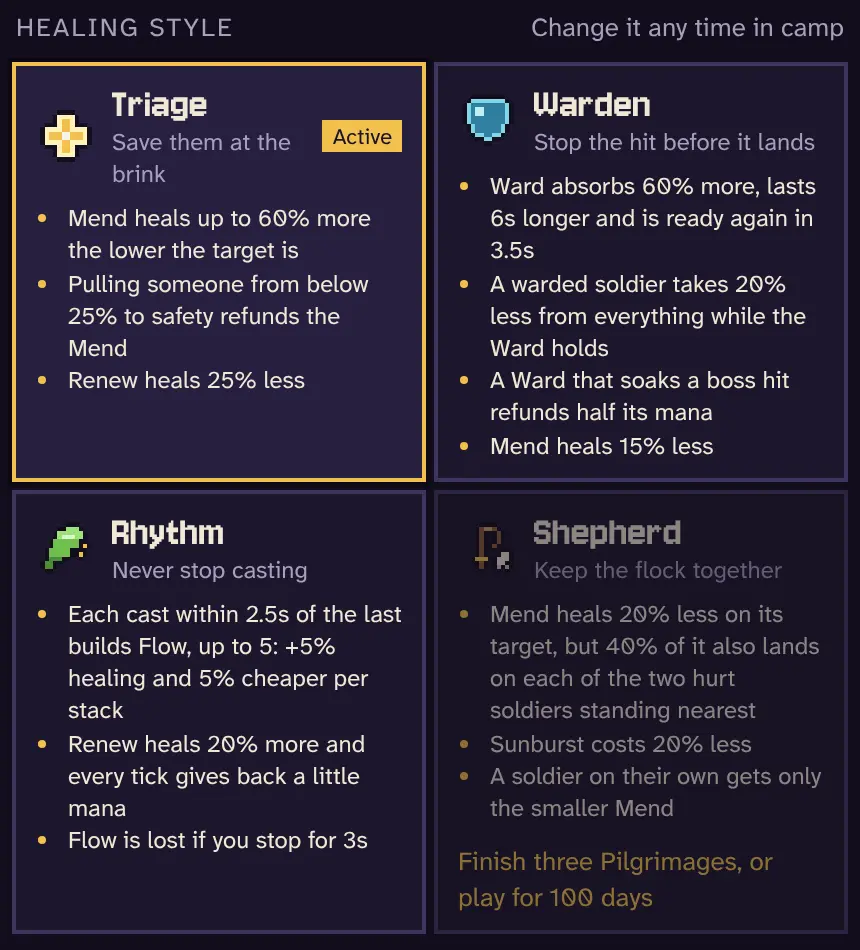
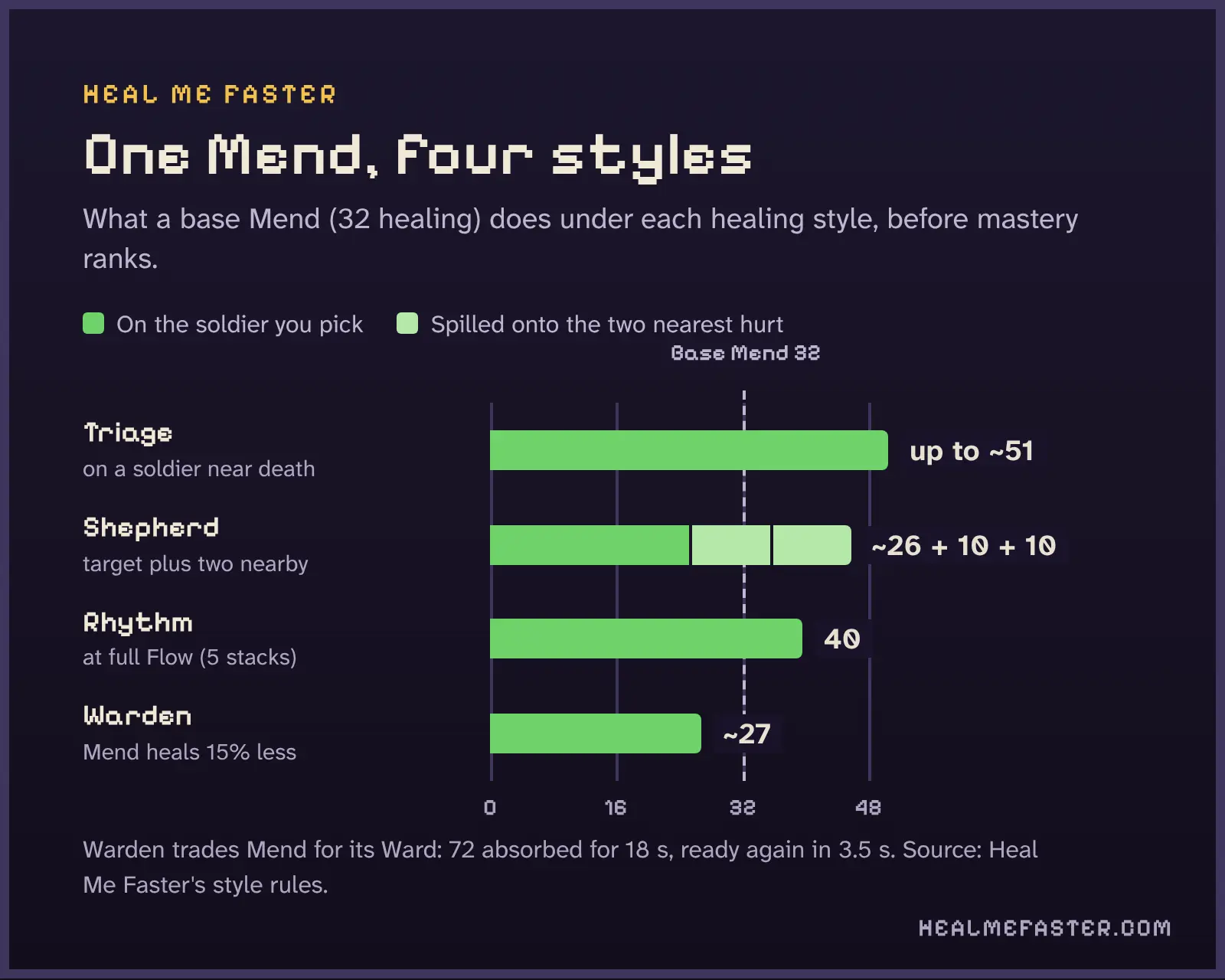
Triage: "Save them at the brink." Mend heals up to 60% more the lower the target is, so a base 32 becomes up to about 51. Pulling someone from below 25% to safety refunds the Mend, so a real save costs you nothing. Renew heals 25% less. This is reactive healing with a reward for nerve.
Warden: "Stop the hit before it lands." Ward absorbs 60% more (72 instead of 45), lasts 6 seconds longer and is ready again in 3.5 seconds instead of 5. A warded soldier takes 20% less from everything while the Ward holds, and a Ward that soaks a boss hit refunds half its mana. Mend heals 15% less. Bosses mark their big hits with a red tag on the target's frame, and a Warden lives for that tag.
Rhythm: "Never stop casting." Each cast within 2.5 seconds of the last builds Flow, up to five stacks of 5% more healing and 5% cheaper spells, so at the top you're healing 25% more for 25% less. Renew heals 20% more and every tick gives back a little mana. Stop for 3 seconds and Flow is gone.
Shepherd: "Keep the flock together." Mend heals 20% less on its target, but 40% of it also lands on each of the two nearest hurt soldiers, up to about 46 healing in all. Sunburst costs 20% less. A soldier on their own gets only the smaller Mend. Shepherd opens after three Pilgrimages (a weekend event on the Road), or 100 days of play.
Which healing style suits you?
- Triage if you watch health bars more than the boss, love the last-second save, and hate wasting a heal on someone who'd have lived anyway.
- Warden if you watch the boss, like knowing what's coming, and would rather nothing landed at all.
- Rhythm if you like a steady loop and want every cast to make the next one cheaper.
- Shepherd, once it opens, if the company takes damage together and you like three heals for the price of one.
Coming from an MMO? Holy Priests will likely feel at home in Triage; Discipline Priests, Scholars and Sages in Warden; Restoration Druids in Rhythm. This guide maps the rest of your kit.
Try them yourself
Heal Me Faster comes to Steam on 1 December 2026 for $9.99, on Windows and macOS. On top of the styles there are three talent trees, mastery ranks on every spell and 15 healers to play as. If one of these styles sounds like you, wishlist it on Steam, and practice your triage in the battle on the home page. For healer games you can play today, here's my list of games where you play the healer.
FAQ
What is the difference between reactive and proactive healing?
Reactive healing restores health after damage lands, most urgent target first. Proactive healing spends mana before the damage, with shields and mitigation, so the hit never fully lands. Good healers mix both.
What is triage healing?
Sorting the hurt by urgency and healing whoever will die soonest first, which isn't always whoever has the lowest health bar.
Are shields better than direct heals?
Only against damage you can see coming. A shield stops a telegraphed hit before it lands, but a shield on someone who isn't hit just expires.